



$ 9.95
| /
5101 Brake Fluid Moisture Tester – Water Content LED Meter
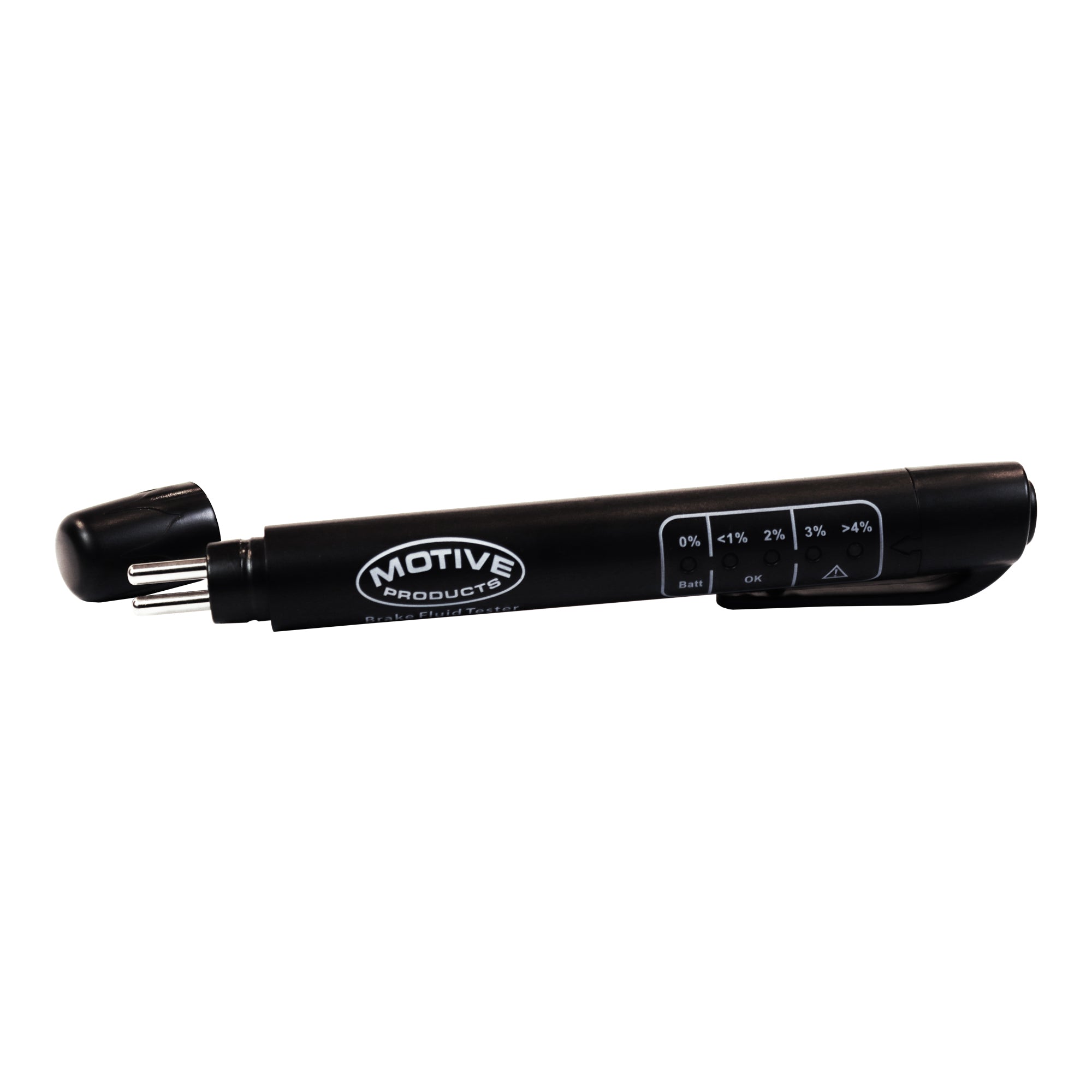
The Motive Products 5101 Brake Fluid Tester gives technicians and DIYers an instant, accurate read on brake fluid condition. Insert the probe, press the button, and a 5-LED bar graph displays water content from 0% to 4%+ — no test strips, no lab equipment, no guesswork.
Key Features
- 5-LED Bar Graph – clear indication at 0%, 1%, 2%, 3%, and 4%+ water content levels.
- Built-In Self-Test – verify sensor and circuit integrity before every measurement.
- Wide Fluid Compatibility – works with DOT 3, DOT 4, and DOT 5.1 glycol-based fluids.
- Compact & Portable – pocket-sized for on-vehicle reservoir dip or fluid sample testing.
- Long-Life AAA Batteries – hundreds of tests per set; low-power electronics.
Why Moisture in Brake Fluid Is Dangerous
Glycol-based brake fluid is hygroscopic — it absorbs water from the air through hoses, seals, and the reservoir vent. Just 3% water content can drop DOT 4 fluid's boiling point by well over 100°F. Under hard braking, water-contaminated fluid can vaporize in the calipers, and vapor compresses where fluid doesn't: the result is a soft or sinking pedal exactly when you need it most. Moisture also corrodes ABS valves, calipers, and steel lines from the inside out. A 10-second test with a brake fluid moisture tester tells you whether your fluid is safe or overdue for a flush.
How to Test Your Brake Fluid for Moisture
- Run the built-in self-test to confirm the sensor is working.
- Remove the master-cylinder reservoir cap and dip the probe into the fluid (or test a sample).
- Press the button and read the LED bar: green (0–1%) — fluid is healthy; 2% — plan a flush at your next service; 3%+ — flush now.
- Wipe the probe clean and recap the reservoir.
Service Guidelines
- Street use: Flush when tester reads 3% or at 2-year intervals, whichever comes first
- Track / HPDE use: Flush before every event; water-contaminated fluid vaporizes under repeated hard braking
- Fleet / commercial: Log readings at each service interval to trend fluid degradation
Electronic Tester vs. Test Strips vs. Refractometer
Three tools claim to measure brake fluid condition — here's how they differ:
- Electronic tester (5101): reads water content directly by conductivity in ~10 seconds, reusable for hundreds of tests, no consumables. Best for repeat use in a shop or garage.
- Test strips: measure copper corrosion (an indirect proxy for fluid age), not water content, and rely on color-matching by eye. One-time use.
- Refractometer: lab-accurate but slow, needs calibration and a fluid sample, and costs several times more — overkill for routine service.
For fast, repeatable go/no-go checks before a flush, the electronic 5101 is the practical choice. Pair it with any Motive power bleeder kit to test and flush in one pass.
Frequently Asked Questions
Is an electronic moisture tester more accurate than test strips?
Electronic conductivity testers like the 5101 read water content directly in the fluid in seconds, with no color-matching guesswork and no consumables to re-buy — one tester lasts for hundreds of tests.
Does it work on DOT 5 silicone fluid?
No. Silicone DOT 5 fluid doesn't absorb water the way glycol fluids do, so conductivity testing doesn't apply. The 5101 covers DOT 3, DOT 4, and DOT 5.1.
What do I do if my fluid fails the test?
Flush the system with fresh fluid. Pair the 5101 with any Motive Power Bleeder kit for a complete one-person test-and-flush workflow — see the step-by-step instructions and use the Application Guide to match an adapter to your vehicle.